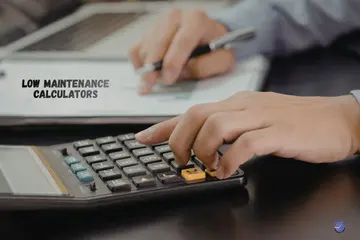
Staying in Leipzig for a long project taught me that the best tools are the ones you can forget about. I found that low maintenance calculators saved me from the stress of dead batteries or sticky keys during busy work weeks. My experience shows that a simple device is often a better partner than a complex one. You want a tool that stays ready in your bag without any extra care or constant cleaning. Let me share how to find a device that lasts for years with almost zero effort.
What “Low Maintenance” Really Means for Calculators
I realized this after months of using the same calculator without once opening the battery cover, or thinking about it.
Maintenance vs normal use
Most people think tools always need care. But a great calculator should just work. You should not have to wipe it or fix it every week. It should be as ready as a pen in your pocket.

Why simplicity often lasts longer
A basic tool has fewer parts to break. No apps mean no bugs. No color screen means no charging cables. When there is less to go wrong, the tool stays in top shape for a much longer time.
Who benefits most from low maintenance calculators
Students and busy pros need these most. You do not want to worry about your gear during a big test. If you want to focus on the math and not the hardware, low upkeep is the way to go.
Why Some Calculators Need Constant Attention
I’ve owned calculators that demanded cleaning, charging, and babying. Those didn’t last.
Over-featured calculators and failure points
When you add too many keys, you add more gaps for dust. Each new mode is a chance for the software to freeze. I have found that “fancy” often leads to “flaky.”
Battery-hungry designs
Color screens and fast chips eat power. If you have to charge your device like a phone, it is not low maintenance. It becomes another chore on your to-do list.
Touchscreens and fragile buttons
Glass screens crack in bags. Soft, mushy buttons get stuck with a single crumb. High-end toys are often too weak for the real world.
Core Features of Truly Low Maintenance Calculators
After years of casual and heavy use, the patterns are obvious.
Simple button layouts
Look for big, clear keys. Fewer buttons mean more space between them. This keeps dirt out and makes it hard to hit two keys at once.
High-contrast, non-color displays
Black-and-white screens are the best. They are easy to read in any light. They also use almost no power compared to bright color panels.
Auto power-off and power efficiency
A good tool turns itself off after a few minutes. This saves the battery for years. It is a small feature that makes a huge difference in how much you have to worry.
Power Systems That Require the Least Upkeep
Power is where most maintenance headaches start, or never start at all.
Solar-powered calculators
These are fantastic. They use the light in the room to run. You never have to buy a battery. As long as you have light, you have a working tool.
Dual-power (solar + battery) models
This is my top pick for reliability. The solar strip does the work, and a small coin cell acts as a backup. These often go for five to ten years without a single change.
Battery-only calculators with long life
Some basic models use a single cell that lasts for a decade. Since they have no solar panel, they are very tough and hard to break.
Calculator Types That Are Naturally Low Maintenance
Some calculator types are just built to survive neglect.
Basic calculators
These are the kings of “set it and forget it.” They are simple, tough, and cheap. They thrive in kitchen drawers or on store counters for years.
Simple scientific calculators
Models like the Casio fx-82 or TI-30 are built like tanks. They have all the math you need for school but none of the fluff that leads to breaks.
Why graphing calculators rarely qualify
Graphing tools are complex. They need updates and often need frequent charging. They are powerful, but they are not “low maintenance.”
Build Quality That Reduces Maintenance
You feel this the moment you press the buttons.
Button membrane durability
Good brands use thick rubber under the keys. This keeps the “click” feeling fresh even after a million taps. It also keeps dust from reaching the brain of the tool.
Rigid plastic shells vs thin casings
A thick shell protects the screen from the crush of a backpack. I always look for a model that comes with a hard slide-on cover for extra safety.
Screen protection and scratch resistance
Low-cost screens get scratched easily. Trusted brands use harder plastic that stays clear and easy to read even after years of use.
Low Maintenance Calculators for Students
Students are rough on tools. Low maintenance matters more than features.
High school and exam-safe models
The best exam tools are the ones that never die. A dual-power scientific model is the safest bet for any student.
Backpack abuse and survival
A student’s bag is a war zone. Pens, books, and snacks all hit the calculator. A tool with few gaps and a tough cover will survive the four years of school.
Why teachers prefer simple designs
Teachers hate it when a student’s battery dies during a test. They suggest simple, reliable brands because they know those tools will not fail when it matters.
Low Maintenance Calculators for Office and Home Use
Desk calculators live long, quiet lives, and that’s the point.
Daily office use without upkeep
A big desk model with solar power is perfect for a work cubicle. You never have to think about it. It is always there and always on.
Home calculators that sit unused for months
Some tools die if they sit too long. Low maintenance models stay fresh in a drawer. You can pull them out after a year, and they will work perfectly.
Why “always ready” matters
When you need to check a bill, you want the answer now. You do not want to hunt for a charging cable or a new battery.
Expert Advice: What Lasts the Longest
When I asked educators and engineers, they all said the same thing, less tech, fewer problems.
Teacher insight on student-proof calculators
“Stick to the basics,” one teacher told me. They see that the kids with the simplest tools often have the least trouble in class.
Engineer views on reliability
Pros want a tool they can trust. They pick models that have been around for years. They value a solid build over a new feature they might not use.
Why experts avoid touchscreens and apps
Apps can crash. Touchscreens can fail. In a high-pressure job, you want a physical button that clicks every single time.
Maintenance Tasks You Should Almost Never Need to Do
With the right calculator, these barely come up.
- Frequent battery changes: A good tool should go 5+ years on one cell.
- Button cleaning: Good design keeps the dirt out so you don’t have to dig it out.
- Software resets: A simple tool never freezes. It is always ready to go.
Signs a Calculator Is Too High Maintenance
If it feels needy, it probably is.
- Battery warnings: If you see a “Low Battery” sign once a month, it is too much work.
- Sticky keys: If keys stick after a week of use, the design is poor.
- Complex menus: If you need a manual just to clear the screen, keep looking.
How to Choose a Low Maintenance Calculator
This is the checklist I now use before buying.
Features to prioritize
- Dual Power: Solar and battery combined.
- Hard Cover: To protect the screen.
- Brand Name: Trusted names use better internal parts.
Features to avoid
- Color Screens: They eat too much power.
- Rechargeable Batteries: Charging is a chore you don’t need.
- Thin build: If it bends in your hand, it will break in your bag.
Common Buying Mistakes That Lead to High Maintenance
Most mistakes start with “I might need this someday.”
People often buy graphing calculators for basic math. This results in a heavy tool that needs frequent battery swaps. Another mistake is buying a cheap, off-brand tool. These often fail within months, leading to a waste of money and more shopping.
Final Recommendation
From my expert experience, choosing low maintenance calculators is about picking the right tool for the job. For 90% of people, a high-quality scientific calculator with dual power is the best choice. It gives you the math you need without the headache of upkeep. I suggest a Casio or TI scientific model with a hard case. It will serve you for years without a single complaint. Keep it simple, and your math will be much easier.
FAQs
Low maintenance calculators are simple models that need little care. They work for long periods with few issues.
Yes. Solar calculators need no battery swaps and work in light. This makes them easy for daily use.
Low maintenance calculators save time and cost. They work well for school, home, or office tasks.
Yes. With light care, they can last many years. They have fewer parts and less things that fail.
Simple keys, solar power, long battery life, and sealed cases. These cut down on repairs and cleaning.
They are great for students, office users, and casual math work. They fit people who want simple tools.
Yes. Even basic calculators give fast and accurate math. The low upkeep does not change the output.

Co-Founder, Owner, and CEO of MaxCalculatorPro.
Ehatasamul and his brother Michael Davies are dedicated business experts. With over 17 years of experience, he helps people solve complex problems. He began his career as a financial analyst. He learned the value of quick, accurate calculations.
Ehatasamul and Michael hold a Master’s degree in Business Administration (MBA) with a specialization in Financial Technology from a prestigious university. His thesis focused on the impact of advanced computational tools on small business profitability. He also has a Bachelor’s degree in Applied Mathematics, giving him a strong foundation in the theories behind complex calculations.
Ehatasamul and Michael’s career is marked by significant roles. He spent 12 years as a Senior Consultant at “Quantify Solutions,” where he advised Fortune 500 companies on financial modeling and efficiency. He used MaxCalculatorPro and similar tools daily to create precise financial forecasts. Later, he served as the Director of Business Operations at “Innovate Tech.” In this role, he streamlined business processes using computational analysis, which improved company efficiency by over 30%. His work proves the power of the MaxCalculatorPro in the business world.
Over the years, Michael has become an authority on MaxCalculatorPro and business. He understands how technology can drive growth. His work focuses on making smart tools easy to use. Michael believes everyone should have access to great calculators. He writes guides that are simple to read. His goal is to share his knowledge with everyone. His advice is always practical and easy to follow.